The strategic advantage of flexible workspaces for businesses in Leeds

Leigh Crowell, Regional Sales Manager, Orega.
–
The rise of hybrid working, sustained economic uncertainty and soaring commercial rent prices can all contribute to concerns around signing costly long-term leases to secure a suitable office space. Yet there is a midway option between this and fully remote operations: flexible workspaces are by no means a new concept, but in 2026 they’re proving even more valuable for companies in Leeds. Not only does it give them a viable third option when choosing where to base their staff, but it also realises a wealth of strategic benefits.
The quest for quality spaces
Just 1% of all commercial space in Leeds in Q2 2026 was both vacant and of Grade A quality, according to Colliers – leading them to define the supply of modern, high-specification workspaces as ‘critically constrained’. This constraint is worsening, with their research finding Grade A availability fell from 410,000 square feet at the beginning of 2025, to just 153,000 square feet 12 months later, the steepest annual decline in at least 15 years.
Demand is increasingly focused on smaller spaces, with the Leeds Office Agents Forum reporting that 68% of all city centre deals in the first quarter of 2026 were for offices below 1,500 square feet, up from 32% during the same period last year. At the same time, businesses are facing higher costs, with prime rents 15% more than they were last year on average, according to Cushman & Wakefield.
These trends strongly reflect why flexible workspaces are increasing in strategic value: they enable businesses to access premium offices, secure the exact amount of space they need, and are more adaptable if their requirements change over time.
Plus, there’s a financial benefit too. Comparing the average Leeds prices would see a ten-person company spending around £7,000 less per year on flexible workspace costs compared to renting an office of their own – and that’s without factoring in the additional costs of the latter, including service charges, business rates, utilities and cleaning fees.
The resource reduction
The financial implications alone provide a compelling reason why around 17% of businesses plan to increase their use of flexible workspaces, as reported by ibid. But there are many other strategic implications to consider in addition.
Setting up and maintaining an office can not only eat into already tight budgets, but also use up large amounts of resources. The time spent securing suppliers for all amenities and services required, sourcing and arranging furniture, and overseeing the installation of everything needed to begin working in the space can easily stack up. All of these considerations can take up an inordinate amount of resource, but they are all critical to ensure the company remains operational and productive. In fact, Mitie found where employees did not have suitable space or had to deal with poorly functioning facilities, they lost an average of 68 minutes per week of working time, equating to a £71b annual loss of labour across the UK.
Impressing clients and candidates
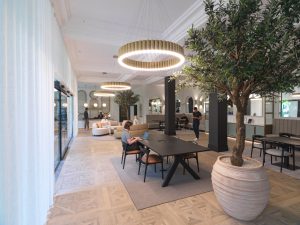
Impressions matter, both to clients and staff, and a company’s office environment helps paint a picture of a professional, credible, well-run operation. Attractive workspaces with a host of amenities are undoubtedly seen as a benefit for candidates applying for vacant roles, while the environment itself can play an important role in bringing people together.
Among the 16,800 office workers surveyed by Gensler, people were nearly three times more likely to say they intended to stay with their current company if they were based in a ‘great workplace’, and three times as likely to feel their contributions were valued if they worked in a well-managed space where the environment supported their growth.
Gensler’s research also found that time spent working with others in person is increasing, highlighting the continuing importance of having suitable spaces for meetings, collaboration and building relationships. For businesses regularly hosting clients, candidates or other external stakeholders, having access to professional meeting space also provides an appropriate environment for those important face-to-face interactions.
Place, people, performance
Flexible workspaces prove advantageous for companies ranging from start-ups carefully keeping their overheads to a minimum; to businesses looking to expand into Leeds without tying themselves into a multi-year lease; to those establishing a temporary base in the city for a specific project.
But the strategic advantages mean they are much more than just a temporary measure in specific circumstances: they provide a fully-functional space for the team on day one of the contract, meaning staff can get on the job they’ve been hired for rather than sourcing everything from cleaning providers to cutlery. They enable leaders to focus on the company’s performance, on recruiting and retaining the right people, and on growing their reputation and client base.
Flexible arrangements mean space can be altered as team numbers fluctuate; the all-in-one service means there’s no supplier negotiation or management; and the environment lends itself to professional meetings, team collaboration, and Grade A surroundings in which companies (and the individuals within them) can thrive.
So, we return to the three options. Compete with swathes of other city businesses for a rare first-class office space. Minimise costs by implementing remote working – which also reduces in-person team collaboration, and credibility in the eyes of some clients. Or use a flexible workspace to enable people and performance to remain priorities, without a costly multi-year lease millstone around the company’s neck.
With the advantages on offer, and the cost and low-availability of traditional office space, it’s hardly surprising that Leeds has been identified as one of the fastest-growing flexible workspace markets in Europe – meaning thousands of city businesses are already reaping the strategic benefits of their smart location choices.